

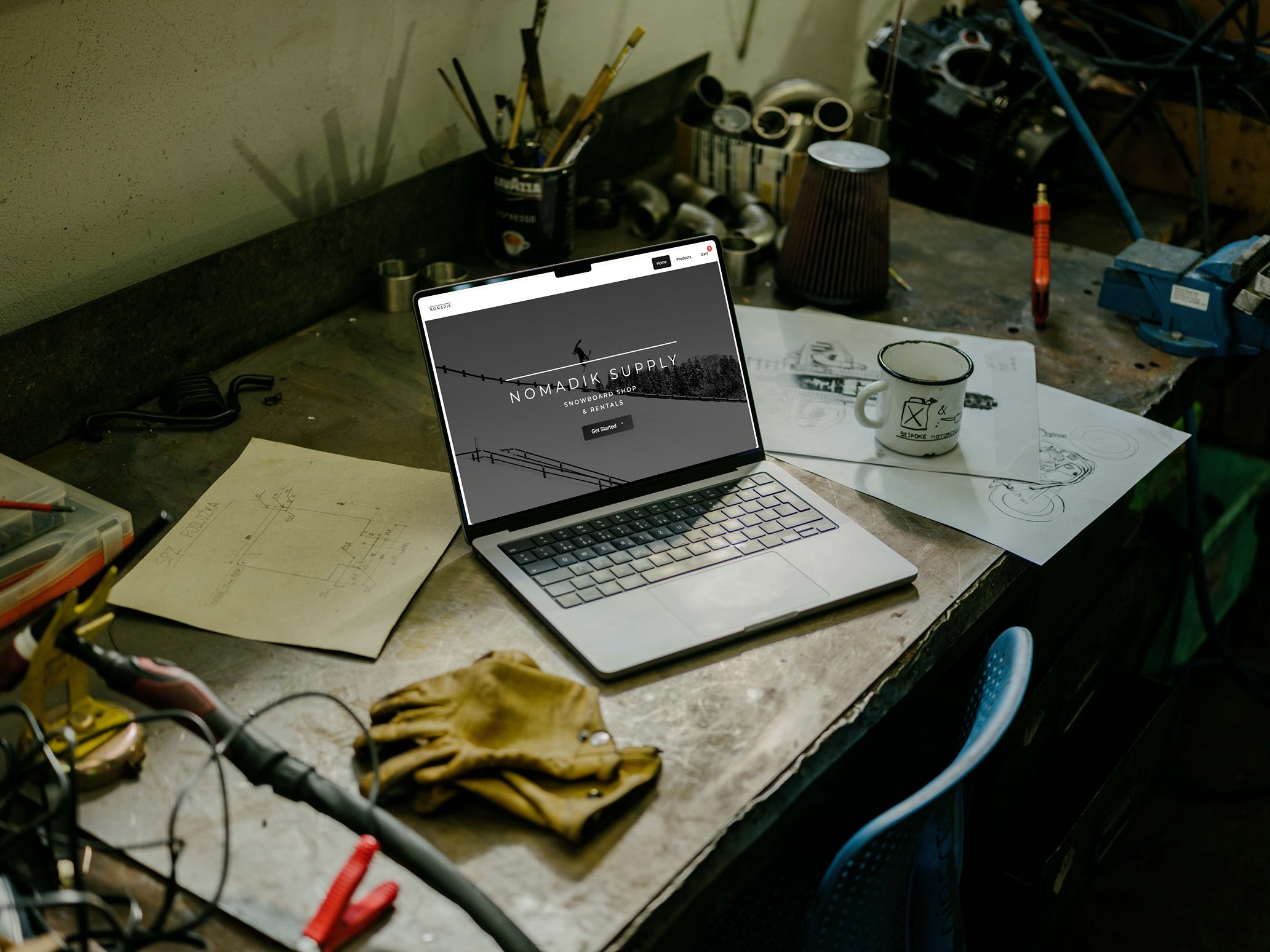
I’ve been experimenting with generative AI for a while now, but I hadn’t had the chance to build a full functional product completely by myself.
The opportunity came up while bouncing ideas with a good friend who is helping the team at Nomadik Supply grow their business in Japan. With the country’s tourism booming, Nomadik wants to make it easy for both international and local snowboarders rent their gear online. The key differentiator with other stores is the idea to build a recommendation engine where users can enter their preferences and the system returns the right gear for them. From there, they can smoothly go through the checkout flow and have their gear ready to go.
When we started talking about this we were sure we would need an engineer to help us build it but within a couple months, these tools and my curiosity had advanced to the point that it pushed me to dive right in.
I ended up building a full stack web application with consumer-facing features and an admin dashboard for the shop owners to manage bookings and inventory.
I used Claude for requirements, guidance, and debugging, and Lovable for AI-assisted development.
Here’s a bit of the process:
I started jamming on Claude, feeding it the general idea and structuring a Product Requirements Document. I mapped the complete user journey and used Claude to generate a series of sequential prompts specifically tailored for Lovable’s AI-assisted approach. This structured approach was super helpful as each prompt built logically upon the previous one.
For the backend I used Supabase and a few of its specific features to solve different things:
PostgreSQL database to store products, bookings with customer information and rental dates.
Row Level Security policies to allow anonymous users to create bookings but restrict viewing to authenticated administrators.
Authentication to handle admin login with email/password credentials and protected routes throughout the admin portal.
Supabase Storage hosted all product images uploaded by the shop owner, automatically generating public URLs that we stored in the database and displayed throughout the customer-facing application.
Edge Functions executed server-side logic for triggering email notifications after successful bookings, ensuring that both customer confirmations and shop owner alerts were sent reliably.
Ironically, I was curious to see if I could completely skip generating designs on Figma and dive straight to building. Lovable uses shadcn/ui, a component library styled with Tailwind CSS which gave the application a clean and responsive design right from the start. I didn’t have to feed a single design asset into Lovable.


The whole process ran pretty smoothly but I did run into a few issues that I debugged with Claude:
A state management issue where rental dates weren’t persisting from the recommendation form to the results page.
A critical failure that was blocking bookings to be completed. This led deep into Supabase Row Level Security, where we discovered no policies existed allowing anonymous users to insert bookings.
Plus a couple others.
With the UI and user flows in a good place, it was time to move on to performance and error handling. Comprehensive availability validation was implemented with multi-stage checks at cart addition, checkout initiation, and final booking creation to prevent race conditions. Error handling was upgraded throughout with specific, user-friendly messages replacing generic failures.
Performance optimizations touched multiple layers: images were compressed to WebP with lazy loading, database indexes were added to frequently queried columns, React code was split between admin and customer bundles, and caching headers were configured. SEO fundamentals included meta tags, structured data, and alt text.
I tested end to end flows, finished touching up the UI, and boom this product was ready to be used.


Challenges
Technical debt. As a designer with little knowledge of programming, there was times I felt completely dependent of AI talking to AI. This did push me to ask these tools to explain what was going on and how to solve it. Even though Claude successfully debugged every issue that Lovable ran into, I want to be conscious that this code is not perfect and I want to get a set of human engineer eyes on it before launching it into the world.
Takeaways
Not my first time feeling it but I do find funny this new type of dopamine hit. Every time these tools are able to produce pretty much exactly what we have in mind, I get the satisfaction and excitement of being able to create something that wasn’t there before.
The fun of building simple technology. As a product designer at Nuvocargo, we build software to disrupt the complex world of logistics and that comes with a lot of technical challenges: validations, APIs, endpoints, webhooks, queries, payloads, and so on. Building a product like this one was just fun.
Our skills evolve with technology. I kept feeling like building this in the past with my existing skillset would’ve been pretty much impossible. I like to think that these technological advancements are also pushing us to step out of our comfort zone, develop new skills, and do things that we couldn’t do before.
Couldn't agree more. It's truly amazing how fast AI tools empower someone to go from an initial idea to a full-stack product. As a teacher, I'm always thinking about how this changes development. I'm so curious about the learning curve for Lovable – was generating those sequential prompts for the user journey quite intuitive? You've realy shown what's possible!